info@labomiz.com
info@labomiz.com
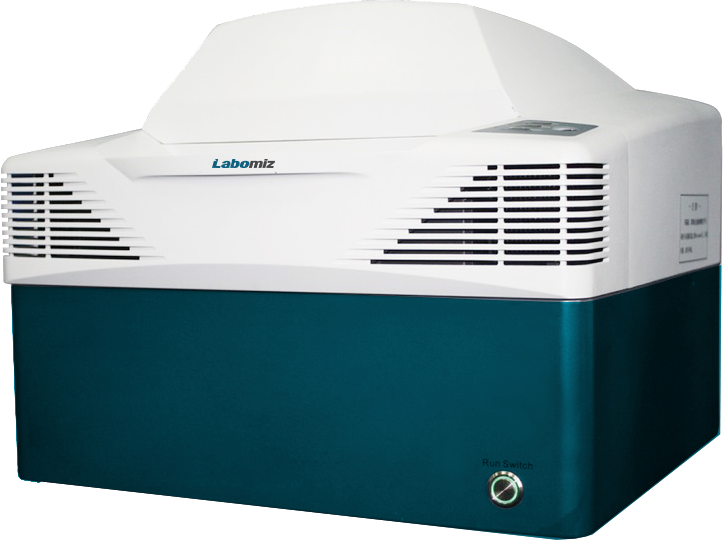
Real Time PCR MLRTP-2B
Real time PCR MLRTP-2B comes with 96 well capacity PCR machine with, 1 to 36°C gradient temperature range, and fast speed dual colour scanning mode. Its wide fluorescence wavelength range with innovative 4 channel design, optimizes thermal performance and maximizes convenience during operation. With its unique Block dissipation technology, it provides precise temperature control and thermal gradient which easily optimizes PCR assays.
| Sample Capacity | 96-Well PCR plate12 × 8-strip 96 × 0.2 ml(Bottom Transparent) |
| Emission Wavelength | 500 to 800 nm |
| Excitation Wavelength | 300 to 800 nm |
| Sample Volume Range | 5 to 100μl |
| Program | Max 20 Segments for Each Program, Max 99 Cycles |
| Dynamics Range | 10 to 1010 Copies |
| Max. channels number of fluorescence detection | 4 channels |
| Detected Fluorescence | F1 : FAM, SYBR Green 1; F2 : VIC, HEX, TET, JOE; F3 : CY3, NED, TAMRA; F4 : ROX,TEXAS-RED |
| Block Temp. Range | 4 to 105℃ (Minimum Increment: 0.1℃), SOAK Low Temp. Conservation Function |
| Temp. Control Accuracy | ≤ ± 0.1 ℃ |
| Temperature Fluctuation | ≤ ± 0.1 ℃ |
| Temperature Uniformity | ≤ ± 0.3 ℃ |
| Ramping Rate | 4.0 ℃/sec |
| Temperature Control Mode | Block/Tube Simulation Mode (Automatic Control based On Sample Volume ) |
| Gradient Temp. Range | 1 to 36 ℃ |
| Hot-lid Temp. Range | 30 to 110℃ (Adjustable, default 105℃, Automatic Hot-lid ) |
| Fluorescence Detection Repeatability | 0.05 |
| Operation Mode | Continuous |
| Scan Mode | Entire Plate or Designated Line |
| Scan Period | 5.5 sec |
| Operation System | Microsoft: Windows2000/XP/vista/Windows7 Software: Excel2003/2007 Access: 2003/2007 |
| PC Configuration | Memory : 512 M; Hard Disk : 10 GB; CPU : Pentium® 4; Virtual Memory : ≥ 1000 MB |
| Power Supply | 100 to 240 V, 50/60 Hz, 600 W |
| Dimension ( L × W × H ) | 430 x 395 x 352 mm |
| Socket | RS 232C Adapter |
Ferrotec Peltier cooler with improved efficiency and long life |
Real time PCR, used in quantification and characterization of nucleic acids in academic institutes, research centres, diagnostics and laboratories.

